Showing posts with label to read. Show all posts

Wednesday, August 15, 2007

Maulana Yunus Patel

Came across this website today, which looks to contain a lot of interesting tidbits, lectures and ebooks. It contains the teachings of a Maulana Yunus Patel, who as best I can tell, traces his teachers back to the Prophet (saws) through Rumi (ra). His biography is quite flowery, but I can't tell much about him from it, unfortunately. Not much comes up in a google search either. There is a contact us option on the website, so inshaAllah I'll do that to find out more about him and his teachings. His website is just put together so darn well, it draws a person in.

I've downloaded his booklet on ikhlas and tafweez for reading inshaAllah.

Tuesday, July 31, 2007

Two great minds, two great articles

Both Tariq Ramadan and Sheikh Hamza Yusuf have recently written pieces on the sad maladies that is anti semetism that infects the muslim ummah.


From Br. Tariq:

The situation is far too serious for one to be satisfied by simple explanations based on current frustrations. In the name of their faith and their conscience, Muslims must take a clear position so that a pernicious atmosphere does not take hold in the Western countries. Nothing in Islam can legitimize xenophobia or the rejection of a human being due to his/her religious creed or ethnicity. One must say unequivocally, with force, that anti-Semitism is unacceptable and indefensible. The message of Islam requires respect of Jewish faith and spirituality as noble expressions of "The People of the Book".


And Sheikh Hamza:

In our inherent contradictions as humans, and in order to validate our own pain, we deny the pain of others. But it is in acknowledging the pain of others that we achieve fully our humanity. A close friend of mine, a professor of religion in a Muslim country for many years, recently told me that his wife, an English teacher in that country, had wanted to use Anne Frank: The Diary of a Young Girl as a text for her Muslim pupils. But the school administrators repeatedly denied her request because they deemed it inappropriate reading for young Muslims. It is sad that the current political morass in the Middle East has led to this intolerable refusal to confront a people’s collective suffering. Perhaps in acknowledging that immense past of Jewish suffering, in which the Holocaust is only the most heinous chapter, Muslims can better help the Jewish community to understand the current Muslim pain in Palestine, Iraq and other places. In finding out about others, we encourage others to find out about us. It would greatly help our Jewish brethren to know the historical facts of Jewish experience in the Muslim world, which are often heartening and humanizing and very different from their European experience. In our mutual edification, we grow together.

inshaAllah ta'ala one day voices like these will be loudly and publically embraced by the majority of the ummah.

Monday, July 30, 2007

The Demise of Imam Faustus

Brother Neurocentric wrote the drama the Demise of Imam Faustus for a group of british muslim secondary students. You can buy the book, and now, you can see parts of it online. Haven't done either yet, but the book is on my to read list, and I'll watch the videos when I get home inshaAllah.

The story of ‘Faust’ has become an important part of modern European mythology as the tale of a man who sold his soul to the devil in return for unlimited power and wealth. Here Faustus rears his head once more at a moment of religious controversy when the role of religion—and of Islam in particular—in society is the subject of fierce debate. The Demise of Imam Faustus, a drama by Matthew Wilkinson deals unashamedly with religious themes: the relationship of man with God and the impact of his conduct in this life on the eternal destination of his soul.

It's been a long time since I've written any scripts, or much of anything of substance asside from college papers. In junior high and high school, I enjoyed writing for the sake of writing, and wrote several short plays to be performed by my church's youth group. But since college, I haven't had that same spark. Br. Neurocentric has written some about his struggles and embrace of writing as a muslim. Definately something to reflect on as I contemplate picking up the pen (or keyboard as it were) again.


Tuesday, July 10, 2007

Ghazzali wishlist

One of my favorite books that occupies a permenant place on my nightstand is "Inner Dimensions of Islamic Worship," taken from the Ihya ‘Ulum al-Din by Imam al Ghazzali.

Aside from wanting to read/own all his works, there are a few Imam al Ghazzali related things that are also on my wishlist:

Al-Ghazali: Alchemist of Happiness dvd
Alchemy of Happiness Hamza Yusuf cd set

I've seen a lot of excellent reviews for both around the net.

Scholars of Peace

via Deenport

The Islamic Tradition and Historic Conflict Resolution in Timbuktu

Fascinating, I hope I can find more on these practices. I took an African History class freshman year, but can't remember much. Guess I'll have to dig around to find my old books and re read about Timbuktu, and browse the Libraries of Timbuktu website.

Tuesday, June 19, 2007

Free books

fisabilillah.org has a number of free books that are available to read online. And, if you right click, copy and paste each page image into a word document, the books become portable. Imagine that, knowledge you can take with you anywhere ;-) There is no copy right to any of the material in the books, so copy and paste away.

I've only looked through the Qur'an related books, but thus far, everything looks peachy keen. According to their about us section, they're decidedly no partisan, but not anti anything. Oftentimes I've found that sites that claim to follow ahul al sunnah wa jamaah are virulently anti madhab, but that doesn't seem to be the case here.

The books on Qur'an are fantastic. Each contains the verse in arabic, a transliteration, and then an easy to read translation. The translation looks to be the Dr. Muhammad Taqi-ud-Din Al-Hilali and Dr. Muhammad Muhsin Khan version I'm not fond of, but with most of the commentary taken out, which is great. The main problem I have with this translation is the insertion of commentary into the text of the translation, which confuses many of the new muslims who receive this Qur'an for free. I can't count how many times I've come across a newbie who believes that the words in brackets are words from the Qur'an, and not mearly the commentary added to explain.

Ah, but I digress. Go, copy and paste, read!

Tuesday, April 17, 2007

Publications from WLUML

Some publications available to download for free from the Women Living under Mulim Law website. Haven't read anything yet, but the Women Reading the Qur'an paper was recommended on a message board I read.

Tuesday, April 10, 2007

Mercy

From the Al-Adab al-Mufrad al-Bukhari (Muslim Morals and Manner of al-Bukhari) chapter on Mercy:

174. The Most Merciful of those in the earth


372. 'Umar was heard to say, "Anyone who does not show mercy will not be shown mercy. Anyone who does not forgive will not be forgiven. Anyone who does not turn in repentance will not be turned to nor will he be protected or guarded."


373. Mu'awiya ibn Qurra reported that his father said, "A man said, 'Messenger of Allah, I was going to slaughter a sheep and then I felt sorry for it (or 'sorry for the sheep I was going to slaughter').' He said twice, 'Since you showed mercy to the
sheep, Allah will show mercy to you.'"


374. Abu Hurayra said, "I heard the Prophet, may Allah bless him and grant him peace, the truthful confirmed one, Abu'l-Qasim, may Allah bless him and grant him peace, say, 'Mercy is only removed from the one who is destined for wretchedness."


375. Jarir reported that the Prophet, may Allah bless him and grant him peace, said, "Allah will not show mercy to a person who does not show mercy to other people."

Friday, April 6, 2007

The Book Foundation

My favorite translation of the Qur'an is the Muhammad Asad translation put out by the Book Foundation. SubhanAllah, it's a gorgeous book, something that is beautiful to look at as well as to read. The translation is easy to understand, has excellent footnotes, and it has accurate transliteration in addition to the english and arabic. If you don't have this book, put it on your list and get it!

The Book Foundation has also published a number of other books that are well worth checking into. If you don't have the $100+ it would cost to buy them all at the moment, the Book Foundation has kindly put up the first parts of each of these books online, mashaAllah. I printed them all out yesterday and have started to read through them. They all get a thumbs up from me thus far.

The Book of Revelations, Selections and Interpretations from the Holy Qur'an, Kabir Helminski, Editor - this is the one that's first on my list to buy. My husband is always telling me to THINK about the Qur'an, not just plow on through. He's excellent at doing that. He'll stop on a verse, pause for a moment, and then expound on it, going on and on and on, tying it to other verses and other subjects for as long as I'll listen to him. This book has 256 verses from the Qur'an with interpretation afterwards. I think it would help me with the thinking and reflecting

The Book of Character, Writings on Virtue from Islamic and Other Sources by Camille Helminski - second on my list to buy. If I could chose to be a scholar of anything, I would be a scholar of adab. Somehow, I feel that most of the world's ills are rooted in the fact that human beings treat each other like crud much of the time. We need a little more adab in this world.

The Book of Language, Exploring the Spiritual Vocabulary of Islam. Kabir Helminski, with Prince Ghazi Bin Muhammad

The Book of Nature, A Sourcebook of Spiritual Perspectives On Nature and the Environment, Camille Helminski, Editor

The Book of Essential Islam by Ali, Aisha, and Aliaa Rafea

The Fragrance of Faith, The Enlightened Heart of Islam by Jamal Rahman

Wednesday, March 28, 2007

Tariq Ramadan is a genius

Seriously. When the man talks, he just makes sense.

Is Islam in Need of Reformation? a lecture by Dr Tariq Ramadan


I'm also reading his book "In the Footsteps of the Prophet," which is excellent as well. I will put up a review when I'm done, I promise.

However, I am stuck midway through "Western Muslims and the Future of Islam." It's a little to academic-y for me at the moment. I think my brain has gone on strike after being in school for, oh 21 years straight. It's unfortunate, because this book is chock full of ideas that every muslim interested at all in the western portion of the ummah should know and be able to discuss.

Monday, February 12, 2007

Declare your faith; live by it

From the Daily Star via Mind, Body, Soul.


In the name of Allah , the Most Beneficent, the Most Merciful:


A person who counts himself among obedient servants of the Lord must testify to faith in the One God and to acceptance of his prophet (Muhammad, Jesus or Moses, peace be upon them all, depending on the religion one follows sincerely). That person must live according to that faith, and go out from the world with faith in hisheart. He protects faith by renewing it daily.


The Creator plants the seed of faith in everyone. If a person mistreats this gift, then he loses everything - the world and the hereafter. He runs to anywhere that he finds material benefit. One’s words may say one thing, but the intention can be something else, and his actions in life becomes worldly. He may forget his faith easily and drop the lifestyle that Allah and his prophets are ordering.


It’s not enough just to say, “I am a believer.” There are people who claim they are believers. But it is only words if they do not look at how they are living and adjust their actions according to intentions, asking why they are living and what is the purpose of life.


Why go to work? Why sleep? Why eat? Why pray? If we don’t know the answer, our actions cannot reflect and support our faith. Holy Prophet Muhammad said, “There is no difference in the Presence of Allah between Arab and non-Arab, except for those who have more taqwa (awareness of God’s presence throughout one’s life).” Those who have taqwa are in higher stations and are closer to their Lord. That’s what we have to run after.


When the sun sets, the angels wrap up another page for that day. They close it, seal it and it’s gone. Whatever our intentions and actions were, we cannot change anything from yesterday. The angels closed that page until Judgement Day. “How did I live today? What did I do? Where did I run? What did I earn? Did I earn only this world? Or did I earn for life hereafter? Or I didn’t earn either one of them?” If we earned the world, and if Allah gives a chance later, maybe one day we will spend that gain in the way of Allah on something for Paradise. We were created as “Ahsani taqweem,” the most perfect creature on earth. If we earned neither the world nor eternity, then shame to us.


We have no guarantee that we will reach tomorrow. If Allah gave both strong spirit and strong physical form and we waste them in questionable places, we will regret later. Every breath is a chance given for another life. Once it’s ordered for us not to inhale the air, we go out with whatever we collected in life. If someone collected material only, he cannot take it with him. Everyone goes empty handed to the grave. If a person runs after empty goals, then he will find emptiness in the grave. If one
runs after something valuable for hereafter, he will find that value in the grave.


And what is of value? To have declared one’s faith, and to have lived by that faith. If you testify and you live according to faith, there is no worry. But if you are claiming and not living according to that faith, then you may not remember to hold onto that faith when the angel of death comes. In the end, many think that the doctor (or the president) is going to help. But that doctor and president are themselves in need of help.


Sheytan gives value to worldly attractions. Be careful. We must not see beauty in what Sheytan is directing. Beauty and value is in what Allah and his prophets ordered. That is Hakk (the Truth). What Allah and his prophets forbid, that is ugly and haram (forbidden). If admiring something forbidden, the heart is with Sheytan, not shining with faith. With faith, wrong things become apparent and you will live
what you believe.


Even if Sheytan makes you dizzy and you aren’t faithful throughout your lifetime, when the death-rope is around your neck, you may say, “Well, I didn’t live according to my faith, but at least let me go out with the faith.” When the angel of death comes, unexpectedly or not, the angels record the last words that come into your heart and out from your mouth.


The chance is given to us in this life to testify to faith and we must live by it. Billions
of people sitting in their graves are wishing that this breath of life would be given back to them once more, just to come to this life momentarily and to be taken away again _ just one breath of life to be given to them to declare their faith.


Sheykh Abdul Kerim al-Hakkani al-Kibrisi is the imam and spiritual leader of the Osmanli Naks-I’bendi Muslim Dergah in Sidney Center.

Friday, February 9, 2007

From the Author of American Islam: The Struggle for the Soul of a Religion

I used to be a fan of Muslim Wake Up, and an excited progressive. Then I joined the PMU (progressive muslim union) mailing list, and found that their big tent wasn't quite big enough to accomidate someone who identified strongly with more traditional interpretations of the faith.

I haven't visited MWU in ages, but on a whim today I decided to, thankfully. Paul Barrett, the author of the new book "American Islam: The Struggle for the Soul of a Religion" that I had previously blogged about has a selection of his chapter on Imam Siraj Wahhaj up. Take a gander:

There may be no better place to take the measure of African-American Islam today than at Masjid At-Taqwa in Brooklyn, N.Y. Formerly a clothing store, then a junkies’ shooting gallery, Taqwa sits at the busy intersection of Fulton Street and Bedford Avenue. In the mid-nineteenth century, free blacks had helped settle the area, now known as Bedford-Stuyvesant. In the 1930s, a new subway line from Manhattan encouraged African-Americans to move to the neighborhood from a crowded and deteriorating Harlem. As the number of blacks in Bedford-Stuyvesant tripled over the next three decades, most whites fled for the suburbs. Housing projects and crime went up; businesses disappeared. Today some blocks are starting to gentrify, but much of the area remains bleak.

At one o’clock one summer Friday afternoon, the jostling to get into the mosque and find a space to sit was getting intense. The imam was in town and would be delivering the khutbah. Some 500 men crowded into the windowless main hall. Among them were cab drivers and security guards, ex-convicts in do-rag stocking caps and merchants wearing embroidered West African robes of crimson and gold. There were school teachers, municipal clerks, and mobile-phone salesmen. Most were American-born blacks, the rest immigrants from Africa, South Asia, and the Middle East. Their shoes were stored in green plastic bags set on long shelves near the door. They sat on dingy gray-striped carpeting laid to indicate the qibla, or direction of prayer toward Mecca. The walls, painted mustard yellow and green, were bare except for a torn poster of the holy city. Invisible from the main hall, a small group of women in headscarves and ankle-length dresses entered through a side door. They sat in a separate room connected via closed-circuit TV.

Wednesday, February 7, 2007

Content of Character

My favorite blogger, Sunni Sister, has finally gotten a computer and is back! As a prelude to her blogging manifesto, she has posted a number of ahadith from Sheikh Hamza Yusuf's translation of Sheikh al Amin Ali Mazrui's "The Content of Character." This book is definately on my to read list.

These ahadith are a representation of another reason I am muslim - the focus on good character. Islam tells us to be good people. It's unfortunate so many muslims forget this. Again, I marvel at the possible future we would have, if only muslims lived Islam.

The Messenger of Allah, sallalahu aleyhi wa ‘ala ahlihi wa sahbihi wa
salaam, said:


“Keep God in mind wherever you are; follow a wrong with a right that offsets it; and treat people courteously.” (Tirmidhi)


“Love for humanity is what you love for yourself.” (Bukhari)


“After obligatory rites, the action most beloved to God is delighting other Muslims.” (Tabarani)


“Should you ever become eager to mention another’s faults, recall your own.” (Rafi’i)


“If your good deeds delight you and your foul deeds distress you, you are a believer.” (Diyya)


“Abandon desire for this world, and God will love you. Abandon desire for others’ goods, and people will love you.” (Ibn Majah)


“The most virtuous behavior is to engage those who sever relations, to give to those who withhold from you, and to forgive those who wrong you.” (Tabarani)


“True spiritual excellence is devotion to God as if you see Him; and though you do not see Him, you at least know that He sees you.” (Bukhari, Muslim)


“What enables people to enter Paradise more than anything is piety and good character.” (Tirmidhi)


“The majority of man’s sins emanate from his tongue.” (Tabarani)


“The servants God loves most are those most sincere with God’s servants.” (Imam Ahmad)


“May God have mercy on a servant who spoke well and gained good, or kept silent and avoided harm.” (ibn al Mubarak)


“Consider well contentment, for it is a treasure without end.” (Tabarani)


“A person has done enough wrong in his life if he simply repeats everything he hears.” (Muslim)


“Veiling the thoughts of the faithful is akin to restoring life to the dead.” (Tabarani)”


“God veils the faults of anyone who suppresses his anger.” (ibn Abi ad Dunya)


“Whoever has no shame before others has no shame before God.” (Tabarani)


“The Muslim is one from whose tongue and hand other Muslims are safe.” (Bukhari, Muslim)


“A person’s spiritual practice is only as good as that of his close friends; so consider well whom you befriend.” (Tirmidhi)


“Speak the truth even though it be bitter.” (ibn Hibban)


“Fulfillment is not plenty of goods; rather it is self-fulfillment.” (Bukhari, Muslim)


“Gentleness never accompanies anything without enhancing it, nor is it ever removed from anything without demeaning it.” (Bayhaqi)


“Beautiful Islam entails minding one’s own business.” (Tirmidhi)

Monday, February 5, 2007

NYT: Tariq Ramadan Has an Identity Issue

http://www.nytimes.com/2007/02/04/magazine/04ramadan.t.html?pagewanted=1&_r=2

I knew there was a reason I liked this guy:

Ramadan’s favorite Muslim philosophers are the late-19th-century reformists Muhammad Abduh and Jamal al-Din al-Afghani, who tried to revive Islam under Western colonial rule by rational interpretation of the holy texts. They were skeptical of religious tradition, accumulated over time, and looked for core principles in the Koran that spoke to reason. For them there was no contradiction between scientific reasoning and their Muslim faith. And female emancipation or democratic government could be reconciled with the original principles of Islam. Both had lived in Europe. Both were harsh critics of colonialism and Western materialism. In Ramadan’s words, “They saw the need to resist the West, through Islam, while taking what was useful from it.”

...

But what exactly are his politics? Ramadan explained to me what shaped his political understanding: “In my family, resistance was a key concept, resistance against dictatorship and colonialism. When I was 18, I started to travel to southern countries, in Latin America, India and Africa. The people I met were often leftists. The liberation theologists in Brazil were very important, resisting in the name of religious principles. I was at home with this discourse. I was also close to the Tibetans and spent one month with the Dalai Lama. It was the same philosophy, spiritual commitment and resistance, in their case against Chinese colonialism. Perhaps because of these personal experiences, I started to read the work of my own grandfather, who used the Scriptures, the story of Moses, against British colonialism. He was saying in the 1940s what the liberation theologists were saying in the 1960s."

Must set asside some money to pick up his new book.

Thursday, February 1, 2007

Keep your tongue moist with the Rememberance of Allah (swt)


Abdullah ibn Busr (ra) narrated that:

A man came to the Prophet (saws) and said, "Oh Prophet of Allah, the laws of Islam have become too much for us. So, is there one thing that we can hold on to that would be inclusive (of many other things?)"

He (saws) replied, "Keep your tongue moist with the remembrance of Allah, most Exalted, Sublime."

Sahih hadith from Ahmed


SubhanAllah. I was on the bus last night, and getting a little bored of the NPR newscast playing on my ipod. I turned it off, and rummaged around in my purse for something else to keep me occupied. I pulled out "Remember me and I Will Remember You." The preceeding hadith is the first thing in the book after the table of contents. SubhanAllah.

We will often say that Islam is a complete way of life. There is an answer for everything, and as such, there are a lot of rules to follow. I know I will often feel overwhelmed by it all. SubhanAllah, I'm not alone. Even at the time of our blessed Prophet (saws), people felt that all the rules, all the requirements, were too much to bear. How did the Prophet (saws) respond? By berating them? No! By pointing them towards God. Remember God! SubhanAllah. Verily, with God people to find rest.


Sa'd ibn Abee Waqqas (ra) narrated that:

We were with the Prophet (saws) and he asked us, "Is one of you incapable of earning a thousand good deeds every day?"

So one of the people in the audience asked, "How could we get a thousand good deeds?"

So he (saws) said, "Whoever glorifies Allah one hundred times, a thousand good deeds are written for him or a thousand of his bad deeds are removed."

Recorded in Muslim


SubhanAllah (Glory be to God)!

Monday, January 15, 2007

The Islamic Workplace

Dr. Rafik Beekun's blog, The Islamic Workplace collects articles, videos and tips for muslims in the workforce. I'm especially fond of his Positive Quotes section, which contains an eclectic mix of Islam and Business savy

On Ihsan
Allah loves, when one of you is doing something, that he [or she] does it in the most excellent manner.

Muhammad (p) cited in Al-Qaradawi, Yusuf, Dawr Al-Qiyam Wal-Akhlaaq Fi Al-Iqtisaad Al-Islaami. Maktabat Wahbah, 1995.

Wednesday, January 10, 2007

Muslims in print

Ooo, my future library continues to grow. On my lunch time walk today, I wandered into the religion section of Barnes and Noble and came upon several books to add to my to read list.


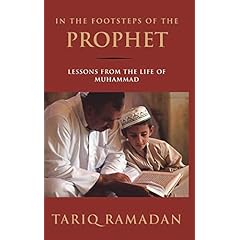
One of the reasons I am a muslim is because I love the Prophet Muhammad (saws). When I picked up my first biography of the Prophet (saws), I felt an instant attachment to this man. His life is full of poweful examples of how a good person should live, full of compassion, mercy and justice. Tariq Ramadan's new book In the Footsteps of the Prophet: Lessons from the Life of Muhammad highlights these moments in the Prophet's life. inshaAllah non muslims will pick up this book, as opposed to say, ones by islamophobes, and will be introduced to this fantastic man and to Islam.


Freelance monotheist and scholar Karen Armstrong is out with another book about the Prophet (saws), that I think I blogged about earlier.

In addition to these books about the Prophet (saws), American Muslims are getting some literary attention as well.


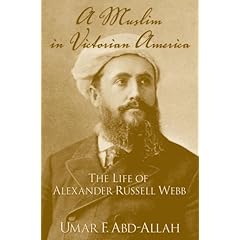
Dr. Umar Abd-Allah of the Nawawi foundation has written a book about the Life of Alexander Webb, an convert to Islam in Victorian America. From the description, it seems that Webb's life can provide insight into the formation of an American Muslim identity:


In every aspect of his life except his adopted faith, Abd-Allah shows, Webb was quintessentially a man of his place and time. It was because he was so typically American that he was able to serve as Islams ambassador to America (and vice versa). As Americas Muslim community grows and becomes more visible, Webbs lifeand the virtues he championed pluralism, liberalism, universal humanity, and a sense of civic and political responsibility exemplify what it means to be an American Muslim.


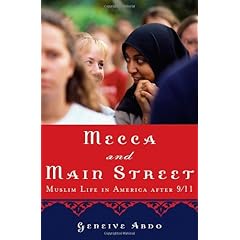
The Amazon reviews of Mecca and Mainstreet: Muslim Life in America after 9/11 are mixed, but I'd still like to look through it.


NPR did a book review that I'll be listening to soon inshaAllah.


American Islam: The Struggle for the Soul of a Religion was on display in the new book section of Barnes and Noble. It has chapters on the Imam (Siraj Wahhaj,), the Publisher (Osama Siblani), the Scholar (Khaled Abou El Fadl) and the Femenist (urg) among others. Since I haven't read the book yet, I wonder how much it goes into the diversity within each of these categories. Khaled Abou El Fadl is vastly different from Sheikh Hamza Yusuf, and yet both are American Muslims scholars. There are hundreds of muslim femenists out there, as demonstrated by the WISE conference held last year. Why did Mr. Barrnet chose Asra Nomani? Hmmm...

Which leads me on another tangent. My husband and I were talking the other day about what we would do if we had an unending source of income. One of the things that I'd like to do is go back to school, either to study law or to get a masters. If I get a masters, I'm thinking I'd like to study Muslims in America. I wrote a paper on the development of Muslim participation in American politics for an undergrad course. I really enjoyed the research, and I spend plenty of time ruminating on the development of a distinct american muslim culture and identity. Now, if only I didn't hate actually writing papers so much. Bah.

Thursday, December 14, 2006

The American Muslim

The American Muslim is an excellent online journal to browse through when one has the time. There are two articles in particular that stood out to me today, because they speak to the problems I have encountered on the net and in real life in defending Islam and muslims.

Selective Hearing of Muslim Voices Against Extremism and Terrorism addresses the pervasive assertion that muslims in general and american muslims in particular are silent on the issue of terrorism. During college, I was a board member of my university's Muslim Student Association. Part of being a muslim student representative and a hijabi on campus is that you're visibly muslim, and as such, often called upon to answer people's questions about Islam. For the most part, I enjoy these questions coming from my fellow students and from the occasional reporter. But, there was always that underlying assumption that even if I wasn't a member of a terrorist organization, I was at least a terrorist sympathizer. No matter what proof I would bring, the long lists of condemnations, it all fell on deaf ears. I guess this is a problem many muslims encounter.

The second article is The Dehumanization of American Muslims, another phenomenon I've witnessed and experienced with growing concern over the years. Read it.

Dehumanization is defined as a process by which members of a group of people assert the “inferiority” of another group through subtle or overt acts or statements. Dehumanization may be directed by an organization or may be the composite of individual sentiments and actions.


A coalition of anti-Muslim bigots have formed that sit at their computers full time seeking out news – no matter how vague – of bad Muslim behavior to demonstrate to their growing numbers of readers that all Muslims are irreparably evil and ultimately must be put into internment camps and/or systematically eliminated whether by getting them to leave Islam or by killing them.


Their assault on Islam and the Muslims is unrelenting and uncompromising. There are no good Muslims. If you meet a good Muslim, then he/she is making ‘tuqiyyah’ and/or part of a “sleeper cell”. Muslims can do no good. NONE!


Their blogs are growing in readership. They are coming out with more and more best selling books smearing and slandering Islam and the Muslims, and are continuously invited back to major media outlets to promote their books and offer their “expertise” on Islam.